How to Build Daily Visibility in an AI-First Search Environment

I hope you enjoy reading this blog post. If you want my team to just do your marketing for you, click here.
Author: Jeremy Haynes | Published March 11, 2026
Earnings Disclaimer: You have a .1% probability of hitting million-dollar months according to the US Bureau of Labor Statistics. As stated by law, we can not and do not make any guarantees about your own ability to get results or earn any money with our ideas, information, programs, or strategies. We don’t know you, and besides, your results in life are up to you. We’re here to help by giving you our greatest strategies to move you forward, faster. However, nothing on this page or any of our websites or emails is a promise or guarantee of future earnings. Any financial numbers referenced here, or on any of our sites or emails, are simply estimates or projections or past results, and should not be considered exact, actual, or as a promise of potential earnings – all numbers are illustrative only.
If you’re running an agency that’s already doing six or seven figures and you’re trying to figure out what daily execution actually looks like for continued growth, you need to understand something critical.
The game is changing faster than most operators realize.
We’re moving into an environment where traditional traffic strategies are becoming obsolete. The whole landscape is shifting underneath us, and if you’re not building the right daily habits now, you’re going to wake up in six months wondering where all your organic traffic went.
I’m talking about a fundamental shift in how people find information, how they consume content, and how they make buying decisions.
And the businesses that are going to adapt are the ones that build one specific growth habit into their daily execution starting right now.
This is exactly the kind of operational framework we cover inside Master Internet Marketing, my 7-week live comprehensive training where I walk through these systems in detail with agency operators.
Results are not typical. Your results will vary and depend entirely on your individual capacity, business experience, expertise, and level of desire. There are no guarantees concerning the level of success you may experience. The testimonials and examples used are not intended to represent or guarantee that anyone will achieve the same or similar results. We don’t believe in get-rich-quick programs. We believe in hard work, adding value and serving others. As stated by law, we can not and do not make any guarantees about your own ability to get results or earn any money with our information, courses, programs, or strategies.
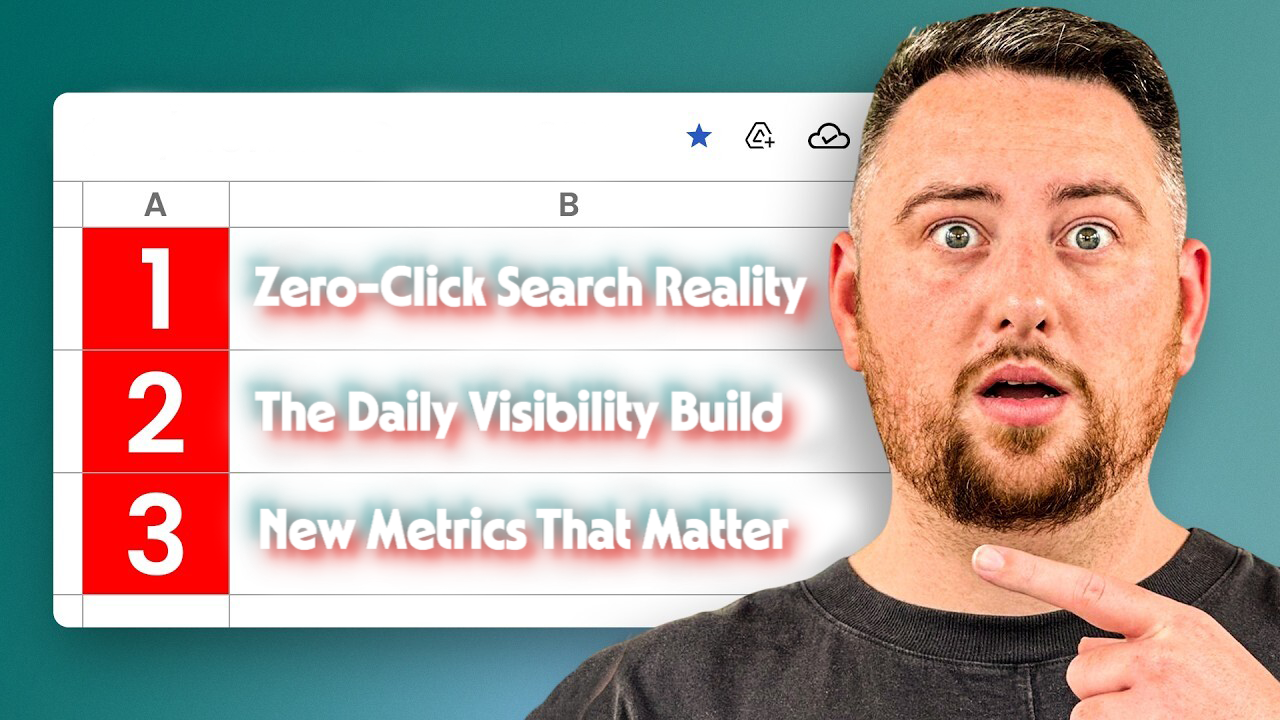
Why Zero-Click Search Is Changing How Agencies Think About Traffic
What’s happening that most people aren’t paying attention to is this.
Google processes trillions of searches annually. But the problem is this: according to SparkToro’s research on zero-click searches, the majority of those searches are becoming zero-click searches.
That means people are getting their answers directly in the search results or AI overviews without ever clicking through to your website.
By the end of this year and into next, this is only going to accelerate. AI overviews are taking over the top of search results, and they’re answering questions completely before anyone ever reaches your site.
If your entire growth strategy depends on people clicking through from Google to your website, you’re building on a foundation that’s crumbling.
In my experience, businesses that haven’t adapted to this shift see significant drops in organic traffic. And it’s not coming back.
The businesses I work with that are still growing their organic reach have made one critical adjustment. They’ve changed what they’re optimizing for every single day.
The Daily Visibility Habit That Gets You Cited by AI Tools
The one habit that’s going to separate the businesses that continue growing from the ones that plateau is what I call the daily visibility build.
This isn’t about posting more content for the sake of posting. It’s not about churning out blog posts that no one reads.
It’s about spending 30–60 minutes every single day building visibility in the places where your buyers are actually looking for solutions.
What that looks like in practice:
Every day, you’re creating or optimizing one piece of content specifically designed to show up in AI overviews, ChatGPT responses, and other AI-powered search tools. You’re structuring it so that when someone asks an AI tool for recommendations in your space, your business is the one that gets cited.
The shift is clear. You’re not optimizing for clicks anymore. You’re optimizing for citations, for mentions, for being the answer that AI tools pull when someone asks a question in your domain.
According to Search Engine Journal’s coverage of AI overviews, this shift toward AI-generated answers is fundamentally changing how SEO professionals approach content strategy.
Why Video Content Shows Up in AI Results More Than Text
Another piece most people are missing:
Video is showing up in a significant portion of AI overview results now. That number is only going up.
If you’re not creating video content as part of your daily habit, you’re leaving massive visibility on the table.
But I’m not talking about producing Hollywood-level video content. I’m talking about simple, direct videos that demonstrate your expertise and can be repurposed across multiple platforms.
Spend 15–30 minutes a day creating short video clips. These could be quick tips, answers to common questions, or breakdowns of concepts in your industry.
Then take those clips and distribute them across LinkedIn, YouTube, TikTok, Instagram, wherever your buyers are spending time.
The reason video works so well in this new environment is that it provides clear signals to AI systems. When you have a video with proper annotations, transcripts, and structure, AI tools can understand and reference that content more effectively than plain text.
Plus, when AI tools share video content, your branding stays intact. With text, it often gets reprocessed and rewritten. With video, people see you, hear you, and connect with your brand directly.
How to Diversify Your Traffic Sources Beyond Search
The other critical component of this daily habit is channel diversification.
You cannot rely on search traffic alone anymore. Period.
Businesses that are growing in this environment are building audiences across multiple channels simultaneously: email, social, community platforms, all of it working together.
I structure this as a daily habit:
Day one: focus on email nurture. Send value to your list, build relationships, and keep your brand top of mind.
Day two: engage in your community. This could be LinkedIn posts, comments in industry groups, or direct outreach to potential partners or clients.
Day three: test how your content performs in AI queries. Use ChatGPT or other AI tools to search the types of questions your ideal clients ask, see if your content shows up, and adjust based on what you find.
This rotation ensures you’re not over-dependent on any single channel. When search traffic dips, your email list keeps you stable. When social algorithms change, your community keeps you visible.
The Content Marketing Institute’s research on multi-channel distribution shows that businesses with diversified content distribution see more consistent engagement across their marketing efforts.
The businesses I work with that have the most predictable revenue growth are the ones that have built this diversification into their daily execution. It’s not a project they do once a quarter. It’s part of how they operate every single day.
How to Use AI Tools for Content Personalization at Scale
Where this gets really powerful for businesses already doing volume:
You can use AI tools daily to personalize your content and outreach at a level that was impossible even two years ago.
Use machine learning to predict behavior and adapt your messaging based on how different segments of your audience interact with your content.
Small daily actions here compound massively. Use AI to analyze which email subject lines perform better for different audience segments. Use it to identify which video topics resonate most with which buyer personas.
Then create adaptive content that changes based on user behavior. Someone who’s engaged with three of your videos gets a different email sequence than someone who’s only downloaded one resource.
This level of personalization used to require massive teams and huge budgets. Now it’s something you can build into your daily habit with the right tools and systems.
The businesses that are adapting fastest are the ones using AI not just for content creation, but for behavior prediction and adaptive engagement. That’s where the real leverage is.
Cultural Relevance: A Daily Scan
One thing I see a lot of operators miss is the importance of cultural relevance.
You can have the best SEO, the best AI optimization, and the best video content, but if you’re not tapped into what’s actually happening in your industry and the broader culture, your content falls flat.
Part of your daily habit needs to be a cultural scan. Spend 10–15 minutes every day reading what’s trending, what conversations are happening, and what your ideal clients are talking about on social media.
Then create content that ties into those conversations, not in a forced way, but in a way that demonstrates you’re plugged in, you understand the moment, and you have valuable perspective to add.
This is how you build organic engagement that compounds over time. Paid media can get you attention, but cultural relevance builds genuine connection and authority.
The businesses I work with that have the strongest brand positioning are the ones that have made this daily cultural scan a non-negotiable part of their routine.
A 90-Day Implementation Plan
Let me break down how to implement this as a daily habit that sticks.
First 30 days: establish the baseline. Spend 30–60 minutes every day on your visibility build, even if it feels like you’re not seeing immediate results. Create one piece of optimized content daily (a blog post, a video, or a detailed social post). Structure it for AI visibility: clear headings, direct answers to specific questions, multimedia elements, and strategic internal linking. Track new metrics: AI visibility, email open rates, social shares, and community engagement.
Days 30–90: refine based on what’s working. Double down on the content formats and topics that are getting traction in AI tools. Cut what’s not moving the needle. Start building systems: batch content creation, bring in a team member for distribution, and focus on creation and optimization.
The key is consistency. This habit only works if you’re executing daily, not when you feel like it, not when you have time. Every single day.
New Metrics That Matter
Traditional metrics are becoming less useful in this new environment. You need to start tracking different signals to know if your daily habit is actually building momentum.
AI visibility: How often does your brand or content show up when you search relevant queries in ChatGPT, Perplexity, or other AI tools? This is your new search ranking.
Engagement depth: Not just page views, but time on site, video watch time, email click-through rates, social comments, and shares. These signals tell you if your content is resonating.
Channel diversity: What percentage of your leads and revenue is coming from each channel? If one channel is over half your business, you have a vulnerability.
Conversion velocity: How long does it take someone from first touch to becoming a client? As you build better visibility and relevance, this timeline should compress.
The businesses that grow consistently aren’t guessing about what’s working. They have clear visibility into these metrics and they’re adjusting their daily habits based on real data.
Common Mistakes When Building the Habit
Let me save you some pain by calling out the mistakes I see operators make when trying to build this habit.
They try to do too much. Being on every platform and creating every type of content leads to burnout and inconsistency. Pick one or two channels where your ideal clients actually spend time and master those before expanding.
They focus on volume over quality. Posting every day without optimizing for AI visibility or providing real value is ineffective. Better to create three exceptional, well-optimized pieces per week than seven mediocre pieces.
They ignore the data. Build the habit but also review weekly metrics to know if it’s working.
They rely too heavily on paid media. Paid ads have their place, but if that’s your only growth lever you’re vulnerable. The daily habit I’m describing builds organic, compounding visibility that doesn’t disappear when you stop spending.
Why This Habit Works for Agencies
This daily habit is specifically designed for businesses trying to break through to the next level.
It’s built on compound growth, not linear growth. Every piece of content, every optimization, and every relationship adds to a foundation that keeps working for you.
It’s resilient. Six months from now, the content you’re creating today can still be generating visibility and being cited by AI tools, unlike paid media where leads stop when spending stops.
It’s diversified. Multiple channels working together create a growth engine that’s predictable and resilient.
It’s built on real authority and relevance. You’re building genuine expertise and visibility in your market, not tricking algorithms.
That’s the kind of foundation that supports sustainable growth.
How to Start Your Thirty Minute Daily Visibility Habit Right Now
If you’re serious about building these systems into your agency, start this habit today. Not next week. Not after your current project. Today.
Block 30–60 minutes on your calendar for your daily visibility build and make it non-negotiable.
Start with one piece of optimized content (a blog post answering a specific client question, a video breaking down a concept, or a detailed LinkedIn post on a trending topic).
Structure it for AI visibility: clear headings, direct answers, and multimedia elements when possible.
Distribute it across your channels: email your list, post on social, add to your website.
Track initial metrics: Did it show up in AI searches? Did it get engagement? Use that data to refine tomorrow’s content.
Do this every day for 30 days and you’ll start seeing the compound effect. Do it for 90 days and it becomes a growth engine.
If you want to go deeper on these frameworks with direct implementation support, check out Master Internet Marketing, my 7-week live comprehensive training where I walk through these systems step by step with agency operators.
Results are not typical. Your results will vary and depend entirely on your individual capacity, business experience, expertise, and level of desire. There are no guarantees concerning the level of success you may experience. The testimonials and examples used are not intended to represent or guarantee that anyone will achieve the same or similar results. We don’t believe in get-rich-quick programs. We believe in hard work, adding value and serving others. As stated by law, we can not and do not make any guarantees about your own ability to get results or earn any money with our information, courses, programs, or strategies.
Get my content first on Google
Add jeremyhaynes.com as a preferred source and Google shows my articles more prominently in your search results, including AI Overviews and AI Mode.


Jeremy Haynes
Owner and CEO of Megalodon Marketing
Jeremy Haynes is the founder of Megalodon Marketing. He is considered one of the top digital marketers and has the results to back it up.