Low Ticket to High Ticket Ascension: Framework and Implementation

I hope you enjoy reading this blog post. If you want my team to just do your marketing for you, click here.
Author: Jeremy Haynes | Published February 27, 2026
Earnings Disclaimer: You have a .1% probability of hitting million-dollar months according to the US Bureau of Labor Statistics. As stated by law, we cannot and do not make any guarantees about your own ability to get results or earn any money with our ideas, information, programs, or strategies. We don’t know you, and besides, your results in life are up to you. We’re here to help by giving you our greatest strategies to move you forward, faster. However, nothing on this page or any of our websites or emails is a promise or guarantee of future earnings. Any financial numbers referenced here, or on any of our sites or emails, are simply estimates or projections or past results, and should not be considered exact, actual, or as a promise of potential earnings – all numbers are illustrative only.
There’s a specific way to structure low ticket to high ticket ascension that most businesses completely miss. I’ve spent over a decade refining this approach, and in my experience, it can become a meaningful revenue stream when implemented correctly.
Most people screw this up from the start. They create a low ticket offer that actually sabotages their high ticket sales instead of feeding into them.
Let me break down exactly how I approach this.
How the Costco Business Model Explains Low Ticket to High Ticket Ascension
Before we get into the tactics, you need to understand what I’m actually talking about here. This isn’t some new concept. Businesses have been doing this for a long time.
Take Costco as an example. According to Business Insider’s analysis of Costco’s pricing strategy, they maintain extremely thin margins on products compared to traditional retailers. Their concession stand items are priced at cost or below. Same with their samples, their gas, and their tire services.
What’s brilliant about it is that every single one of these things gets you into the store. Once you’re there waiting for your tires to get changed, what are you going to do? You’re going to walk around and buy a bunch of stuff you didn’t plan on buying.
That rotisserie chicken in the back of the store? You have to walk past dozens of items to get there. Each one is a buying decision. That’s intentional.
The real profit for Costco comes from the memberships and all the impulse purchases people make while they’re there. That’s the model we’re replicating with low ticket to high ticket ascension.
If you want to go deeper on building ascension models and product ecosystems, my 7-week live comprehensive training covers the full framework for structuring offers that feed into each other.
Results are not typical. Your results will vary and depend entirely on your individual capacity, business experience, expertise, and level of desire. There are no guarantees concerning the level of success you may experience. The testimonials and examples used are not intended to represent or guarantee that anyone will achieve the same or similar results. We don’t believe in get-rich-quick programs. We believe in hard work, adding value and serving others. As stated by law, we cannot and do not make any guarantees about your own ability to get results or earn any money with our information, courses, programs, or strategies.
Why Your Low Ticket Offer Needs to Deliver a Marginal Result, Not the Full Promise
Most people mess this up completely. Your low ticket offer needs to deliver what I call a marginal result.
A marginal result is a piece of the pie, not the whole pie. It’s enough to make someone think they really need that bigger thing, but not so much that they feel completely satisfied.
Speed to result is critical here. If your low ticket product takes too long to deliver results, people will tell your sales team they don’t think it makes sense to buy the high ticket thing yet because they haven’t gotten results with the low ticket thing.
That’s death for your ascension model.
The result has to be fast, valuable, and leave them wanting more. Think of it like the samples at Costco. You taste it, you realize it’s good, and you want to buy the full thing.
How to Calculate the Satiation Timeline for Your Product Ladder
This is the foundational point that matters more than anything else. You have to understand the satiation timeline, which is the time it takes for someone to feel satisfied after they buy your product.
When you’re hungry and you order food at a restaurant, are you satisfied when you order? No. You’re satisfied when you’ve eaten the food and it was good.
Businesses I’ve worked with often make this mistake. They sell a low ticket product that promises too big of a result with too long of a timeline. If it takes someone a year to get the result from your low ticket thing, your probability of upselling them drops.
I worked with a client selling an offer that taught people how to start an entire business. The timeline to see results? Six months to a year. That’s way too long. We had to restructure the entire offer because the satiation timeline was working against their ascension rates.
Harvard Business Review’s research on customer lifecycle management shows the timing of follow-up offers significantly impacts whether customers engage with them. This aligns with what I’ve seen in my own business. The satiation timeline determines when your ascension sequence should activate.
How I Structure My Own Product Tiers from Training to Done for You Services
Let me show you how I structure this in my own business. My low ticket offer is my 7-week live comprehensive training. Notice I said seven weeks. That’s intentional.
Results are not typical. Your results will vary and depend entirely on your individual capacity, business experience, expertise, and level of desire. There are no guarantees concerning the level of success you may experience. The testimonials and examples used are not intended to represent or guarantee that anyone will achieve the same or similar results. We don’t believe in get-rich-quick programs. We believe in hard work, adding value and serving others. As stated by law, we cannot and do not make any guarantees about your own ability to get results or earn any money with our information, courses, programs, or strategies.
The timeline is tight. Under two months, you go through the program and come out the other side with a marginal result. You’re more competent as a marketer, but you also realize there’s so much more depth available.
My Inner Circle is the premium mastermind. It’s twice-a-month one-on-one calls, weekly group calls, quarterly in-person masterminds, and an active group chat. The result is bigger, the speed is faster because of the accountability, and the impact is substantially greater.
Results are not typical. Your results will vary and depend entirely on your individual capacity, business experience, expertise, and level of desire. There are no guarantees concerning the level of success you may experience. The testimonials and examples used are not intended to represent or guarantee that anyone will achieve the same or similar results. We don’t believe in get-rich-quick programs. We believe in hard work, adding value and serving others. As stated by law, we cannot and do not make any guarantees about your own ability to get results or earn any money with our information, courses, programs, or strategies.
Then there’s Megalodon Marketing, our done-for-you agency services. This is where we actually do the work for you. Biggest result, fastest speed, highest investment.
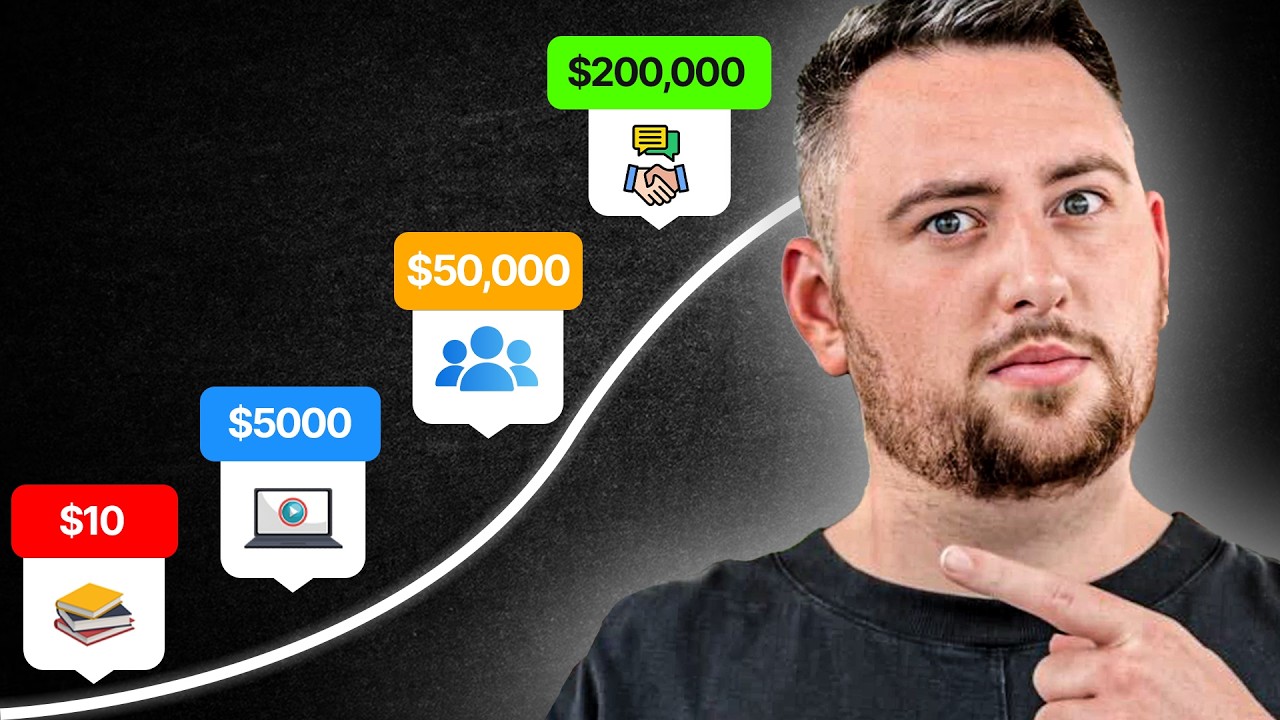
See how that works? Each tier delivers a bigger result faster, and each one costs more accordingly.
The “On Your Own, Done With You, Done For You” Model Explained
Most businesses follow an on-your-own, done-with-you, done-for-you model. This works across product and service businesses.
On-your-own is the least expensive.
Done-with-you is the middle product.
Done-for-you is the most expensive.
But here’s the critical part: the claims can’t be the same across all three tiers. If your low ticket product promises the same end result as your high ticket product, you’re dead in the water.
The low ticket thing can’t promise the full result. That’s not a marginal result. If someone believes they can get that from the cheap thing, why would they ever buy the expensive thing?
My 7-week live comprehensive training doesn’t promise a specific outcome. It promises you’ll become a more confident, capable digital marketer. My Inner Circle is designed to help you improve your business month over month. Megalodon Marketing is designed to dramatically increase the probability you reach your goals with hands-on execution.
Results are not typical. Your results will vary and depend entirely on your individual capacity, business experience, expertise, and level of desire. There are no guarantees concerning the level of success you may experience. The testimonials and examples used are not intended to represent or guarantee that anyone will achieve the same or similar results. We don’t believe in get-rich-quick programs. We believe in hard work, adding value and serving others. As stated by law, we cannot and do not make any guarantees about your own ability to get results or earn any money with our information, courses, programs, or strategies.
Different claims. Different scopes. Different timelines.
How to Implement CRM Notifications, Email Sequences, and Remarketing for Ascension
Once the timeline for your low ticket result has passed, that’s when you activate the ascension sequence. There are three components to this:
CRM notifications. After the respected timeline passes, the CRM should notify the salesperson who closed that individual to reach out. This isn’t a hard sell. It’s a permission-based conversation, for example, asking if they’re comfortable hearing about the next thing that might make sense for their journey.
Marketing automation. Salesforce’s State of Marketing report shows marketing automation remains one of the most effective tools for customer lifecycle management. I approach it this way:
After the timeline passes, send an email that acknowledges they’ve gone through the material.
Ask if they’d like to submit a testimonial.
Ask permission to share information about other offers you think would benefit them.
Include two links: one for yes and one for no.
If they click yes, immediately notify your sales team and take them to a page with a video explaining the higher ticket offer. If they click no, put them into a nurture sequence focused on ensuring they get the result with what they already purchased.
Contextual remarketing ads. This is a small daily budget in most cases. You’re remarketing to people who’ve achieved the low ticket result and communicating about the higher ticket offer.
These three things working together can become a meaningful part of your business. In my experience, they can contribute substantially to overall revenue when implemented correctly.
Why Your Low Ticket Product Timeline Needs to Be Weeks, Not Months or Years
Remember, your low ticket product can’t sell too big of a result. If it’s an on-your-own type product and you’re selling someone on starting an entire business, that timeline might be a year. That’s not fast at all.
The probability of upselling is diminished when you sell too big of a result at the low ticket level.
Compare that to my 7-week live comprehensive training. The timeline is defined. It’s bounded. People know exactly what they’re getting into, and they come out the other side within two months feeling like they received valuable information in a tight timeline.
Results are not typical. Your results will vary and depend entirely on your individual capacity, business experience, expertise, and level of desire. There are no guarantees concerning the level of success you may experience. The testimonials and examples used are not intended to represent or guarantee that anyone will achieve the same or similar results. We don’t believe in get-rich-quick programs. We believe in hard work, adding value and serving others. As stated by law, we cannot and do not make any guarantees about your own ability to get results or earn any money with our information, courses, programs, or strategies.
That’s intentional. It’s designed to get them a marginal result quickly, so the bigger thing makes sense to purchase shortly after.
How to Separate Your Claims Across Low, Mid, and High Ticket Offers
Your low ticket, mid ticket, and high ticket offers need very evident differences in their claims. They can’t all promise the same thing.
I’m not telling people who join my 7-week live comprehensive training that they’re going to hit a specific revenue number. That’s not even remotely close to the expectation. The claim is you’ll become a confident digital marketer.
My Inner Circle’s claim is we’re going to help you improve your business. We’re going to work on that every month. But we’re not promising a specific number.
Results are not typical. Your results will vary and depend entirely on your individual capacity, business experience, expertise, and level of desire. There are no guarantees concerning the level of success you may experience. The testimonials and examples used are not intended to represent or guarantee that anyone will achieve the same or similar results. We don’t believe in get-rich-quick programs. We believe in hard work, adding value and serving others. As stated by law, we cannot and do not make any guarantees about your own ability to get results or earn any money with our information, courses, programs, or strategies.
When we work with Megalodon Marketing clients, we attempt to only take on people who we believe have the capacity to reach their goals. But even there, the expectations are clear. We’re going to work hard on their behalf, but outcomes depend on many factors.
These are very important distinctions for the differences in what you’re communicating at each tier.
How to Train Your Sales Team on Permission-Based Ascension Conversations
When your sales team reaches out after someone’s gone through your low ticket thing, it can’t come off as a hard sell. It has to be permission-based.
Train your salespeople to approach it like an opportunity, not a pitch. For example, express that you’re glad they went through the material and ask if they’re comfortable hearing about something that might make sense for their next step.
Most people will say yes to hearing you out if they actually got value from the first thing. If they say no, that’s fine too. It’s usually a timing issue or they only wanted the result the low ticket thing provided.
The key is making sure they feel like it’s their choice, not something being forced on them.
What to Audit in Your Current Ascension Model Before Building New Sequences
Look at your current low ticket offer and ask yourself these questions:
What’s the timeline for someone to get the result? Is it too long? The result needs to be achievable in weeks, not months or years.
Is the result marginal or is it the full promise? If you’re promising too much, you’re working against your ascension model.
Are your claims separated across your different tiers? Each tier should promise a bigger result that comes faster with more support.
Do you have the three technical components in place? Sales team notifications, marketing automation sequences, and contextual remarketing ads all need to be deployed after the satiation timeline passes.
These systems are designed to work for businesses that are already generating revenue and looking to add another revenue stream. This isn’t beginner stuff. This is for operators who understand their business and want to optimize their ascension model.
When you get this right, you can add meaningful revenue without dramatically increasing your ad spend or acquisition costs. You’re just maximizing the value of customers you’re already bringing in.
That’s the power of mastering low ticket to high ticket ascension.
If you’re ready to implement these frameworks with direct guidance, the Inner Circle is where we work through this together with twice-monthly one-on-one calls and weekly group sessions.
Results are not typical. Your results will vary and depend entirely on your individual capacity, business experience, expertise, and level of desire. There are no guarantees concerning the level of success you may experience. The testimonials and examples used are not intended to represent or guarantee that anyone will achieve the same or similar results. We don’t believe in get-rich-quick programs. We believe in hard work, adding value and serving others. As stated by law, we cannot and do not make any guarantees about your own ability to get results or earn any money with our information, courses, programs, or strategies.
Watch the video:
Get my content first on Google
Add jeremyhaynes.com as a preferred source and Google shows my articles more prominently in your search results, including AI Overviews and AI Mode.


Jeremy Haynes
Owner and CEO of Megalodon Marketing
Jeremy Haynes is the founder of Megalodon Marketing. He is considered one of the top digital marketers and has the results to back it up.